
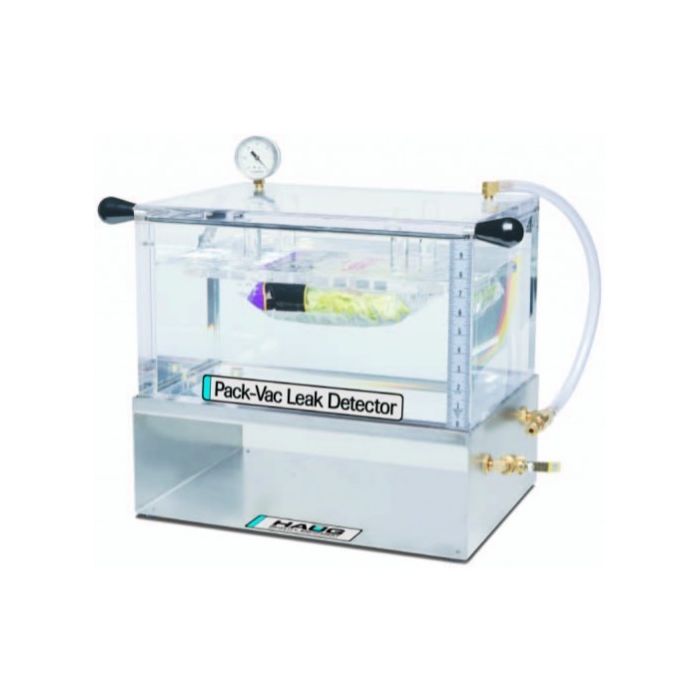
Haug Pack-Vac Packaging Leak Detector
Pack-Vac Leak Detectors help verify package integrity before products leave the facility
Fast Packaging Leak Testing for Food, Pharmaceutical and Industrial Applications
Haug Pack-Vac package leak detectors are designed to help manufacturers verify seal integrity, packaging material performance and package durability before shipment. They are especially useful in applications where seal failures can lead to product loss, contamination concerns, customer complaints or transportation-related damage.
A packaging quality control program that includes Pack-Vac leak detectors can help improve packaging line setup, reduce troubleshooting time and identify sealing problems before they become recurring production issues. The system offers a practical visual method for evaluating package integrity directly on the production floor or in quality control laboratories.
Pack-Vac leak detectors are widely used in food processing, meat and poultry packaging, pharmaceutical production, medical device manufacturing, cosmetics and industrial packaging operations. Users value them for their straightforward operation, visual leak detection process and compatibility with several ASTM methods related to package integrity and transportation simulation testing.
Visual Vacuum Leak Detection
Pack-Vac leak detectors can perform a vacuum leak test in less than 30 seconds. For most applications, the chamber is partially filled with water during testing, while burst testing applications may be performed dry. Operators simply place the sealed package inside the chamber, close the lid, apply vacuum and observe for escaping bubbles.
This process allows users to quickly identify seal defects, pinholes, weak seals and gross leaks before products are released for storage or shipment.
Applicable ASTM Test Methods
Pack-Vac leak detectors can support several ASTM testing methods related to package leak detection, seal integrity and transportation simulation.
- ASTM D3078: Standard Test Method for Determination of Leaks in Flexible Packaging by Bubble Emission
- ASTM D6653: Standard Test Methods for Determining the Effects of High Altitude on Packaging Systems by Vacuum Method
- ASTM D4169: Standard Practice for Performance Testing of Shipping Containers and Systems
- ASTM D4991: Standard Test Method for Leakage Testing of Empty Rigid Containers by Vacuum Method
- ASTM D5094: Standard Test Methods for Gross Leakage of Liquids from Containers with Threaded or Lug-Style Closures
- ASTM F2096: Standard Test Method for Detecting Gross Leaks in Packaging by Internal Pressurization, when used with the optional adapter
Selecting the Right Package Leak Detector
The best model depends mainly on package size, available utilities and the production environment. Pack-Vac leak detectors are available in several chamber sizes to accommodate both small flexible packages and larger industrial packaging applications.
Connection Requirements
Pack-Vac leak detectors can generate vacuum in two different ways depending on facility utilities. Venturi vacuum generator models operate using compressed air and are commonly selected for production environments with an available compressed air supply. Recommended factory air supply is typically 60-80 P.S.I. and 2-6 C.F.M.
Where compressed air is unavailable, electric models with integrated vacuum pumps provide a convenient alternative. Electric versions include a quiet, durable vacuum pump and standard 115 VAC power unless otherwise specified.
Chamber Size Options
Pack-Vac leak detectors are available in several standard production models. Haug can also manufacture custom chamber sizes for applications where standard dimensions are not suitable. Package samples may be evaluated to help determine the most appropriate chamber configuration.
Haug Quality Equipment manufactures large acrylic vacuum chamber leak detectors with standard internal chamber dimensions up to 32″ x 26″ x 20″. Larger custom chambers are also available upon request.
Q&A
What is a package leak detector used for?
A package leak detector is used to identify leaks, weak seals and packaging defects before products are shipped or distributed.How does a Pack-Vac leak detector work?
The sealed package is placed inside a vacuum chamber, often partially filled with water. When vacuum is applied, visible bubbles indicate a leak or seal defect.What types of packaging can be tested?
Pack-Vac systems can test flexible packaging, rigid containers, food packaging, pharmaceutical packaging, sealed pouches and many industrial packaging formats.What is the difference between compressed air and electric models?
Compressed air models use a Venturi vacuum generator powered by factory air supply, while electric models use an integrated vacuum pump and do not require compressed air.Why is vacuum leak testing important?
Vacuum leak testing helps identify packaging defects that could compromise product quality, shelf life, transportation stability or customer satisfaction.Can Pack-Vac leak detectors support ASTM testing procedures?
Yes. Pack-Vac leak detectors can support several ASTM test methods including ASTM D3078, D6653, D4169, D4991, D5094 and F2096 depending on the application and setup.| Model | Inside Chamber Dimensions | Power Source |
|---|---|---|
| PVCA 110808 | 11″ x 8″ x 8″ | Compressed Air |
| PVCA 181210 | 18″ x 12″ x 10″ | Compressed Air |
| PVEL 181210 | 18″ x 12″ x 10″ | Electric |
| PVCA 201413 | 20″ x 14″ x 13″ | Compressed Air |
| PVEL 201413 | 20″ x 14″ x 13″ | Electric |
| PVCA 242015 | 24″ x 20″ x 15″ | Compressed Air |
| PVCA 302016 | 30″ x 20″ x 16″ | Compressed Air |
| PVCA 322620 | 32″ x 26″ x 20″ | Compressed Air |
| PVCA XXXXXX | Custom | Compressed Air |
Need larger scale equipment for a bigger project?
Our parent site geneq.com works by quote requests, so we can offer a unique price per any combination of items you choose, and the best shipping company/route for weighty items. We distribute the biggest names in the industry since 1972!


