
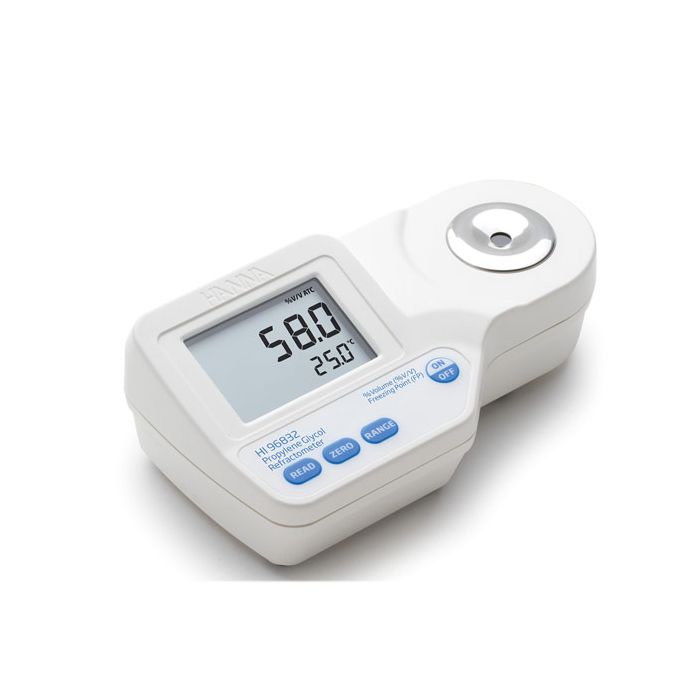
Pocket Refractometer for Analyzing Propylene Glycol
- 12 months limited warranty
- Sample size as small as 2 metric drops (100 μl)
- Sealed stainless steel well with high-grade optical prism made of flint glass
- Fast 1.5 second response time for temperature compensated readings
Hanna digital refractometer for propylene glycol concentration and freeze-protection checks
This instrument is relevant to HVAC technicians, facility teams, solar thermal operators, and maintenance personnel who need to verify propylene glycol concentration and freeze protection in closed-loop systems. Typical use cases include commissioning, preventative maintenance, and troubleshooting where a quick field reading helps confirm system condition.
The HI96832 has a high accuracy of ±0.2% volume and ±0.5 °C freezing point and features a simple operation that gives reliable results each and every time. All readings are automatically compensated for temperature variations and displayed with a 1.5 second response time. The sealed flint glass prism and stainless steel well are easy to clean. Just wipe with a soft cloth in preparation for the next sample.
High accuracy Hanna ph meter shipped for free in Canada
- Designed for propylene glycol analysis
- Automatic Temperature Compensation
- 0 - 100% Volume range with ±0.3% accuracy
- 0 to -50 °C freezing point range with ±0.5 °C accuracy
Learn About the Hanna Instruments Refractometer Propylene Glycol Analysis HI96832
The HI96832 Digital Refractometer for propylene glycol analysis utilizes the measurement of refractive index to determine the percent volume and freezing points of propylene glycol-based solutions. Propylene glycol is used in glycol chillers and dispensing systems intended for food applications, such as beer and wine. Maintaining the appropriate percent of glycol is important in glycol chillers as too low of a percentage could lead to the system freezing and rupturing while too much glycol will reduce the system's efficiency.
The instrument converts the refractive index of a sample to percent volume or freezing point. These conversions are based on internationally recognized references for unit conversion and temperature compensation for glycol solutions (e.g. CRC Handbook of Chemistry and Physics, 87th Edition). The HI96832 is an easy-to-use tool for measuring freezing point and percent volume in propylene glycol solutions, on the production floor or in the lab.
Measurement Units
The freezing point is displayed as a temperature from 0.0 to -51.0 °C corresponding to 0-60 % by volume. When the display shows “LO”, the freezing point is at a minimum (below -51 °C). 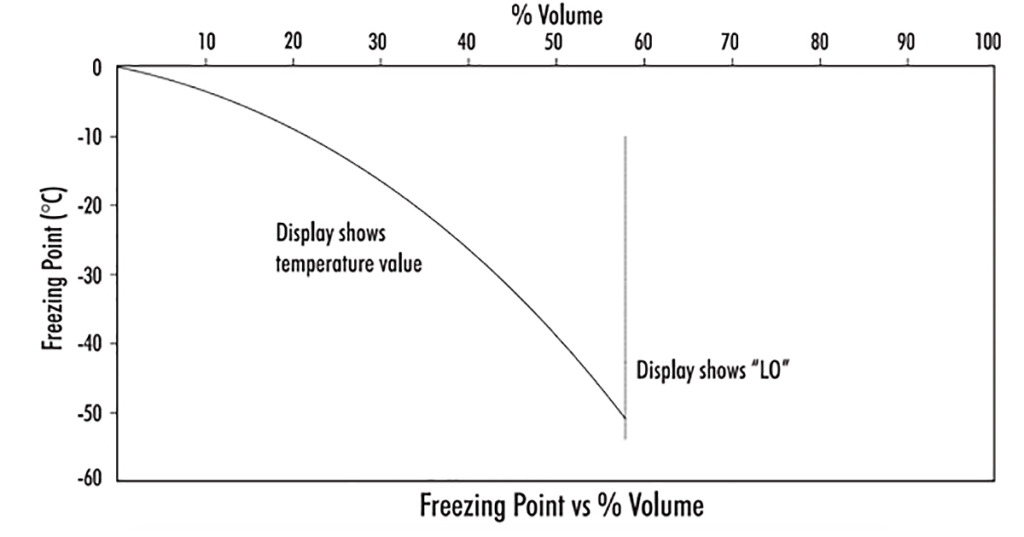
Making a Standard Solution
To make an X % Propylene Glycol Solution, follow the procedure below:
- Place container (such as a glass vial or dropper bottle that has a cover) on an analytical balance.
- Tare the balance.
- volumetrically add X mL of high purity propylene glycol (CAS #: 57-55-2; MW 76.09) to a 100 mL Grade A volumetric flask.
- Use distilled or deionized water to bring the flask close to the total volume, mix, allow the solution to return to room temperature.
- Once the solution has returned to room temperature use distilled or deionized water to bring the total volume to 100 mL. Mix solution well before use.
| Propylene Glycol | Total Volume | Expected Freezing Point Value | |
| 10% V/V | 10.00 mL | 100.00 mL | -3.4 °C (25.9 °F) |
| 40% V/V | 40.00 mL | 100.00 mL | -21.3 °C (-6.3 °F) |
Refractive Index
The HI96832 takes measurements based on a sample’s refractive index. Refractive index is a measurement of how light behaves as it passes through the sample. Depending on the sample’s composition, light will refract and reflect differently. By measuring this activity with a linear image sensor, the sample’s refractive index can be assessed and used to determine its physical properties such as concentration and density. In addition to the linear image sensor, the HI96832 uses an LED light, prism and lens to make measurement possible.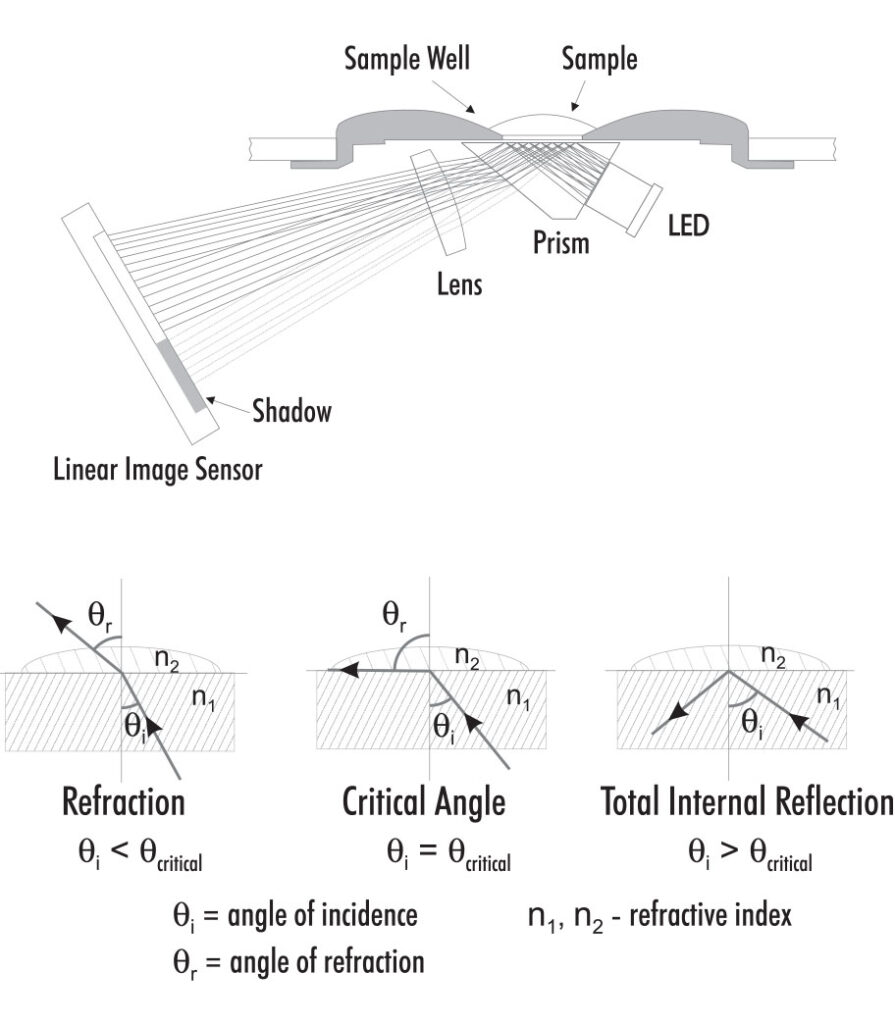 Variations in temperature will affect the accuracy of refractometry readings, so the use of temperature compensation is highly recommended for reliable results. The HI96832 contains a built-in temperature sensor and is programmed with temperature compensation algorithms in accordance with internationally recognized references which vary based on the parameter being measured.
Features at-a-glance:
One-point calibration- Calibrate with distilled or deionized water
- Sample size can be as small as 2 metric drops (100 μl)
- Samples automatically compensated for temperature variations
- Readings are displayed in approximately 1.5 seconds
- The dual-level LCD displays measurement and temperature readings simultaneously
- Easy to clean and corrosion-resistant
- Battery percent level remaining at startup and low battery indicator
- To conserve battery life the meter shuts off automatically after three minutes of non-use
- Water-resistant ABS plastic casing designed to perform under laboratory and field conditions
QUICK TIP:
To change temperature unit: To change the temperature measurement unit from Celsius to Fahrenheit (or vice versa), follow this procedure.
1. Press and hold the ON/OFF key continuously for approximately 8 seconds. The LCD will display the “all segment” screen followed by a screen with the model number on the primary display and the version number on the secondary display. Continue pressing the ON/OFF key.
2. While continuing to hold the ON/OFF key, press the ZERO key. The temperature unit will change from °C to °F or vice versa. Note: The selected unit will be used in Freezing Point mode.
Application Q&A
What does a propylene glycol refractometer help verify?
It helps confirm concentration and related freeze-protection targets in glycol-based systems so operators can maintain the intended balance between protection and performance.
Where is this most often used?
HVAC loops, chillers, hydronic systems, solar thermal installations, and similar applications that rely on propylene glycol are common use cases.
Why choose a dedicated glycol model?
A dedicated scale is more practical for maintenance teams because it matches the fluid and interpretation they care about instead of requiring extra conversion steps.
Because it combines Sample size as small as 2 metric drops (100 μl), Sealed stainless steel well with high-grade optical prism made of flint glass, Fast 1.5 second response time for temperature compensated readings, this model is well suited to field service and maintenance workflows where accurate concentration checks support reliable operation.
| Propylene Glycol Range | 0 to 100% |
|---|---|
| Propylene Glycol Resolution | 0.1 % |
| Propylene Glycol Accuracy | ±0.3 % |
| Temperature Range | 0 to 80°C (32 to 176°F) |
| Temperature Resolution | 0.1°C (0.1°F) |
| Temperature Accuracy | ±0.3 °C (±0.5 °F) |
| Temperature Compensation | automatic between 0 and 40°C (32 to 104°F) |
| Automatic Shut-Off | after three minutes of inactivity |
| Battery Type/Life | 9V / approximately 5000 readings |
| Dimensions | 192 x 102 x 67 mm (7.6 x 4.01 x 2.6”) |
| Weight | 420 g (14.8 oz.) |
| Refractometer Light Source | yellow LED |
| Minimum Sample Volume | 100 μL (to cover prism totally) |
| Sample Cell | stainless steel ring and flint glass prism |
| Measurement Time | approximately 1.5 seconds |
| Ordering Information | HI96832 is supplied with battery and instruction manual |
| Notes | Enclosure Rating: IP65 |
| Price | $USD 221.00 |
|---|
Need larger scale equipment for a bigger project?
Our parent site geneq.com works by quote requests, so we can offer a unique price per any combination of items you choose, and the best shipping company/route for weighty items. We distribute the biggest names in the industry since 1972!


