
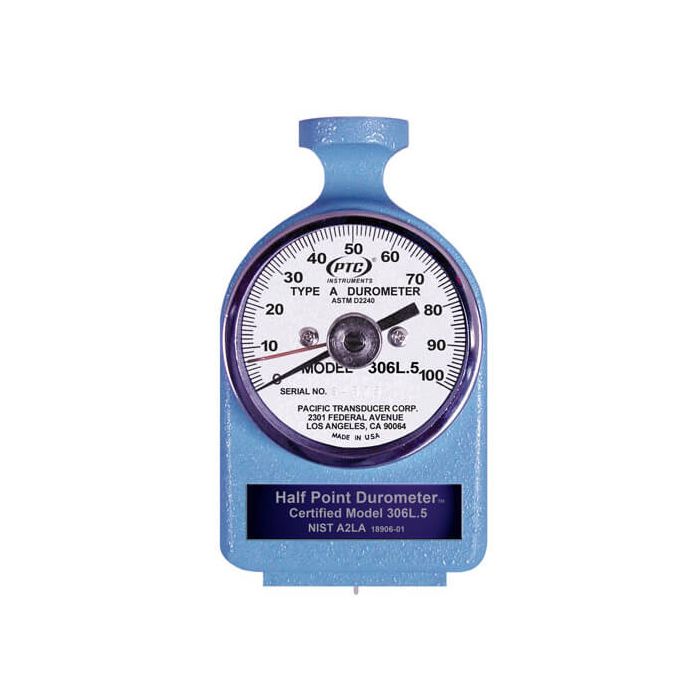
PTC durometer ASTM
- 12 Months Limited Warranty
- Easy to read 0 to 100 point dial
- Accuracy ±1 point
- Max hold pointer standard
Ptc-instruments PTC durometer ASTM for Application-Based Model Selection
These models are designed for intended for buyers comparing closely related models before choosing a final configuration. It is especially useful for routine testing, inspection, and quality-control workflows, where the right choice often depends on differences in configuration, range, portability, and application fit.
The ASTM Model 306L Type A PTC Durometer is designed to measure Type A hardness in accordance with ASTM (American Society for Testing and Materials) D2240 specifications. This includes materials such as rubber, elastomers, and several rubber-like materials like neoprene, silicone, santoprene, vinyl, and butyl. Materials like soft plastics, felt, leather, and similar items usually fall into this same group. The PTC® Model 306L meets or exceeds the most recent ASTM D2240 Standards. The gadget has a matte aluminum surface with prominent, easy-to-read numbers.
The durometer comes standard with a Max Hold function that retains the highest measurement. A top knob with 8-32 threads facilitates easy manual operation and links to test stands or the extra Model 441 1kg Constant Load Deadweight. The Model 441 will allow for even more dependable measurements while taking readings. Each instrument undergoes individual calibration. The durometer includes a testing block and a sturdy carrying case.
The durometer comes standard with a Max Hold hand which retains the peak reading. A top knob with 8-32 threads permits both easy hand held use and attachment to test stands or the accessory Model 441 1kg Constant Load Deadweight. The Model 441 will allow even more consistent measurements when taking readings.
Features - PTC durometer ASTM
- Max Hold Pointer Standard
- Easy to Read 0 to 100 Point Dial
- Accessory Test Stands Available
- NIST/A2LA to ISO 17025 Certification Available
- Includes Precision Aluminum Test Block
- Carrying Case
- 1kg Constant Load Weight Available (Model 441) (SHORE B 306BL, SHORE A 306L.5, SHORE A 306L)
- Threaded mounting knob permits permanent test stand emplacement (SHORE A 306L)
Related Products
For complementary testing solutions, check out the PTC Shore D Durometer for harder materials, the PTC Accessory Test Stands for consistent measurement setups, or the Model 441 1kg Constant Load Deadweight to improve precision in durometer testing.
QUICK TIP:
How to Use a Type A Durometer
The following procedures are based on ASTM Standard D2240. This standard is recognized as being definitive, however, not all applications require such stringent controls. Readings below 10/A may be inexact and should not be reported for some materials. Readings above 90/A should be made on a Type D durometer. The surface of the sample to be tested shall be clean and smooth. The sample should be at least 1/4” (6 mm) in thickness unless it is known that identical results are obtained with a thinner specimen.
Thinner materials can be stacked to obtain the minimum thickness (DO NOT GLUE). Such results may not agree with those of a solid specimen. The sample should be large enough so that the indenter is at least 1/2” (12 mm) from any edge unless it is known that identical results are obtained when measurements are made closer to the edge. The surface of the specimen shall be flat over a sufficient area to permit the presser foot to contact the specimen over an area having a radius of at least 1/4” from the indenter point. The temperature of the specimen should be 73.4°F ±3.5°F (23°C ±2°C).
The specimen should be allowed to rest at this temperature for at least 1 hour prior to testing, as the properties of most materials change with temperature. Place the specimen on a hard, horizontal surface. Set the ancillary hand of the durometer below 5 points on the dial. Hold the durometer vertically with the point of the indenter at least 1/2 “ from any edge. Apply the presser foot to the specimen as rapidly as possible, without shock, keeping the foot parallel to the surface of the specimen. Apply just sufficient force to obtain firm contact between the presser foot and the specimen. Hold for 1 or 2 seconds, the maximum reading can be obtained from the ancillary hand. If other than a maximum reading is needed, hold the durometer in place without motion and obtain the reading after the required time interval. Make 5 tests at least 1/4” apart and use the average value.
CALIBRATION CHECK
For a complete calibration check of mainspring, and visual and mechanical check of the indenter, the instrument should be returned to PTC® (see Guarantee & Calibration Service) or refer to ASTM D2240 Specifications. PTC® recommends the unit be returned at least every 12 months for this check. For a quick field check, follow the guideline below. Under no circumstance should a test block be used as a standard to calibrate a durometer.
1. The pointer should read zero when no force is applied to the indenter of the durometer.
2. Hand hold the durometer and insert the indenter into the hole of the calibrated test block. Apply enough force to make firm contact between the top surface of the test block and the base of the durometer. The dial reading should agree with the value stamped on the check block (±1). Several tests should be made and the results averaged.
3. The indenter must protrude 0.098 to 0.100 inches below the base of the durometer.
4. When the indenter is fully displaced, the durometer should read 100 points. Use care as to not damage the tip of the indenter.
| Scale | SHORE A | SHORE A HALF POINT | SHORE B | SHORE C | SHORE D |
| Model | 306L | 306L.5 | 306BL | 307CL | 307L |
| Range | 0-100 points | 0-100 points | 0-100 points | ||
| Accuracy of | ±1 Point | ±1/2 Point | ±1 Point | ±1 Point | ±1 Point |
| Height | 4 in. (10.2 cm) | 4 in. (10.2 cm) | 4 in. (10.2 cm) | 4 in. (10.2 cm) | 4 in. (10.2 cm) |
| Width | 2-1/4 in. (5.7 cm) | 2-1/4 in. (5.7 cm) | 2-1/4 in. (5.7 cm) | 2-1/4 in. (5.7 cm) | 2-1/4 in. (5.7 cm) |
| Depth | 1-3/4 in. (4.4 cm) | 1-3/4 in. (4.4 cm) | 1-3/4 in. (4.4 cm) | 1-3/4 in. (4.4 cm) | 1-3/4 in. (4.4 cm) |
| Weight | 8 oz. (227 g) | 8 oz. (227 g) | 8 oz. (227 g) | 8 oz. (227 g) | 8 oz. (227 g) |
| Shipping weight | 3lb (1.4kg) | 3lb (1.4kg) | 3lb (1.4kg) | 3lb (1.4kg) | 3lb (1.4kg) |
Product Models
| Product | Price | ||
|---|---|---|---|

|
PTC durometer ASTM - Shore A |
$USD 995.00
|
|
|
|
PTC durometer ASTM - Shore C |
$USD 995.00
|
|
|
|
PTC durometer ASTM - Shore A half-point |
$USD 1,205.00
|
|
|
|
PTC durometer ASTM - Shore D |
$USD 995.00
|
|
|
|
PTC durometer ASTM - Shore A half-point |
$USD 1,205.00
|
|
|
|
PTC durometer ASTM - Shore D |
$USD 995.00
|
|
|
|
PTC durometer ASTM - Shore B |
$USD 995.00
|
|
|
|
PTC durometer ASTM - Shore B |
$USD 995.00
|
|
|
|
PTC durometer ASTM - Shore A |
$USD 990.00
|
|
|
|
PTC durometer ASTM - Shore C |
$USD 995.00
|
|
Need larger scale equipment for a bigger project?
Our parent site geneq.com works by quote requests, so we can offer a unique price per any combination of items you choose, and the best shipping company/route for weighty items. We distribute the biggest names in the industry since 1972!


