
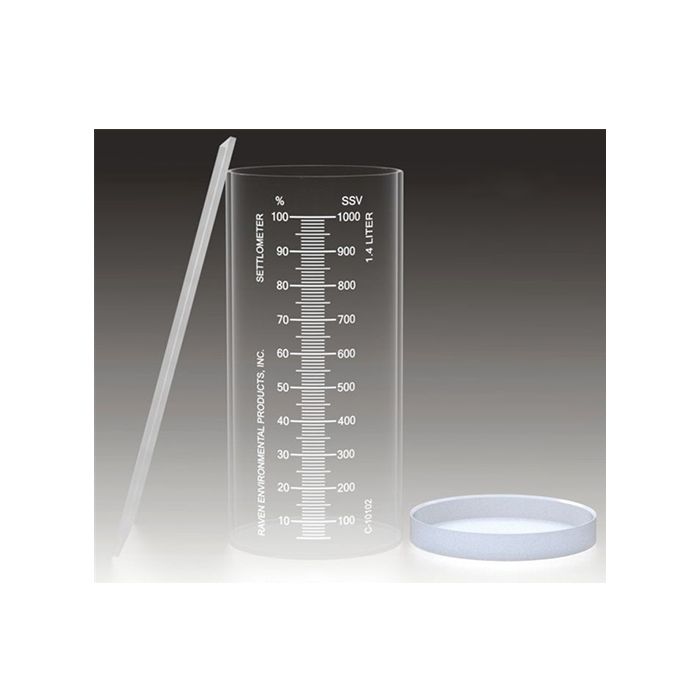
Hach Settleometer for Sludge Volume Index Testing in Wastewater Treatment (RAC10102-0)
- Settleometer Kit with snap on lid and wide stir paddle.
Settleometer for ACTIVATED SLUDGE
"The ability to observe and measure the rate and characteristics of solids separation is essential to control biological treatment processes that produce sludge." Activated Sludge Manual of Practice OM-9
Scientific studies and industry reviews highlight the Settleometer as a key tool in wastewater management. Research has shown that accurately measuring settled sludge volume (SSV) helps optimize secondary clarifier performance, improving effluent quality and reducing solids loss. Peer-reviewed articles and operator reviews confirm that the Settleometer is widely used in municipal and industrial wastewater plants to monitor sludge settling behavior. Customers frequently report that the device is easy to use, provides reproducible results, and is essential for troubleshooting sludge settling issues and optimizing process control.
The Settleometer shows the solids-liquid separation capability in the secondary clarifier. Sludge must separate from the liquid for settling to occur. Settling of sludge in the clarifier is a critical part of the activated sludge process. Poorly settling sludge is a strong indication of process problems and solids loss in final effluent.
The scale printed on the Settleometer measures how far a sample has settled. “SSV” is the abbreviation for Settled Sludge Volume. “%” shows the settled sludge volume as a percentage of the entire sample. The sample to the right has a SSV of 350, which is also 35% of the total sample volume.
Observe Settling Characteristics
Normal sludge forms a floc and gently squeezes the water out of the blanket forming on the bottom. It typically settles between 800 and 700 in five minutes. If there are excess solids in the final effluent with normal sludge, a clarifier mechanical problem may exist. Rapid sludge settles like dark grains of sand, leaving behind a turbid supernatant with suspended solids. It settles to 700 or less in five minutes. Slow sludge appears stuck in the settling process with little or no progress but with a very clear supernatant. It does not settle to 800 in five minutes. Perform the Multi-Dilution test to determine if slow settling is caused by density or concentration.
Troubleshooting Slow Sludge
Slow settling sludge can be caused by high density or high concentration of sludge. The Multi-Dilution Test is performed with two Settleometers to differentiate the cause.
- Density Issue - If the sludge in the diluted Settleometer settles the same as the sludge in the pure Settleometer, this indicates a density issue. Density is related to sludge character. Reducing the pure sample by 50% does not affect the settling characteristic. In other words, the amount of sludge in the sample does not affect settling. Density issues should be investigated further with microscopic evaluation to check for filamentous sludge.
- Concentration Issue - If the sludge in the diluted Settleometer settles significantly more than the sludge in the pure Settleometer, this indicates a concentration issue. Concentration is related to sludge quantity. Reducing the pure sample by 50% allows the sludge to settle further. In other words, the sludge was simply piling up in the pure sample.
Application to Process Control
The Settleometer is used in wastewater plants for several critical applications:
- Assessing settling characteristics – Rapid, Normal, or Slow settling.
- Using SSV to calculate return sludge flow rates.
- Troubleshooting settling problems to identify density or concentration issues.
- Determining timing for denitrification and monitoring when sludge rises to the surface.
Q&A
What is the primary purpose of a Settleometer?
The Settleometer measures the settling rate and characteristics of sludge in wastewater treatment, helping operators monitor clarifier performance and detect process problems.
How is Settled Sludge Volume (SSV) interpreted?
SSV indicates the percentage of sludge that has settled from a sample. Higher percentages indicate better settling, while lower percentages may signal process issues.
How do I differentiate between density and concentration issues?
Perform the Multi-Dilution Test with two Settleometers. If dilution does not change settling, it is a density issue. If dilution improves settling, it is a concentration issue.
Can the Settleometer help with troubleshooting poor effluent quality?
Yes, by identifying slow, rapid, or normal settling characteristics, operators can determine the cause of excess solids in the effluent and take corrective action.
| Price | $USD 108.00 |
|---|
Need larger scale equipment for a bigger project?
Our parent site geneq.com works by quote requests, so we can offer a unique price per any combination of items you choose, and the best shipping company/route for weighty items. We distribute the biggest names in the industry since 1972!


