
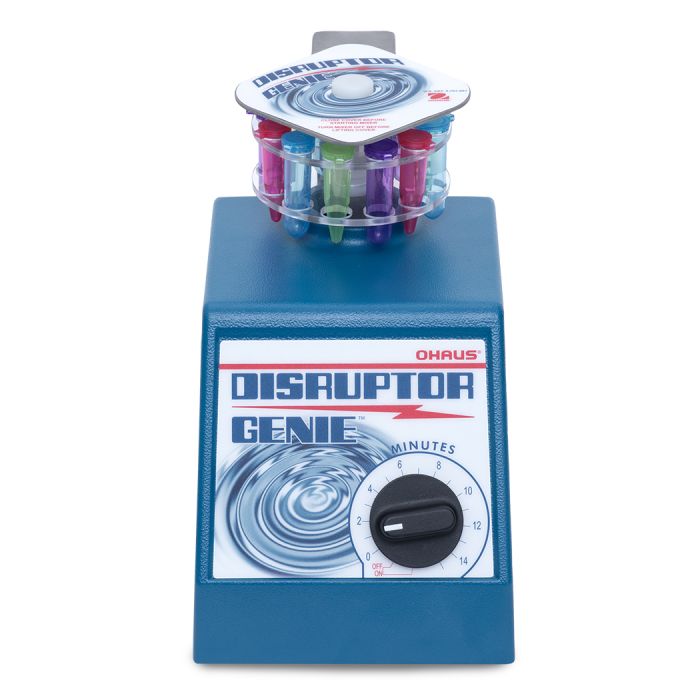
Vortex-Disruptor Genie Cell Disruptors
Vortex-Disruptor Genie Cell Disruptors
High-Intensity Bead Beating for Cell Lysis, Homogenization and Pellet Resuspension
The Vortex-Disruptor Genie family provides vigorous mechanical cell disruption for laboratories that need to release DNA, RNA, proteins and other intracellular material from challenging biological samples. Available as the fixed-speed Disruptor Genie and the adjustable Digital Disruptor Genie, these compact instruments combine high-speed vortexing with a patented multidirectional sample-holder motion that increases bead-to-sample contact.
Each model processes as many as twelve 1.5 or 2.0 mL microtubes at once using glass, zirconia or other suitable disruption beads. The system is designed for bacteria, yeast, fungi, microalgae, plant material, animal tissue and cultured cells, as well as the rapid resuspension of pellets and dissolution of difficult chemical substances.
The Disruptor Genie is particularly useful in molecular biology, microbiology, biotechnology, pharmaceutical, agricultural, food-testing and environmental laboratories. Unlike a conventional single-tube vortex mixer, its enclosed universal microtube holder agitates multiple samples simultaneously while producing multidirectional impacts between the beads and biological material.
Available Vortex-Disruptor Genie Models
Disruptor Genie
The analog Disruptor Genie is intended for routine cell disruption procedures that are normally performed at maximum intensity. It operates at a fixed speed of 3000 rpm on 60 Hz models and includes a mechanical timer that can be set for runs of up to 15 minutes.
A continuous operating position is also available for procedures requiring a longer mixing cycle. Because no speed programming is necessary, the analog model offers straightforward operation for established bead-beating methods that consistently use full-speed agitation.
Digital Disruptor Genie
The Digital Disruptor Genie adds electronic speed and time controls for protocols that require precisely defined and repeatable processing conditions. Speed can be adjusted between 1000 and 3000 rpm, allowing the mixing intensity to be adapted to the organism, tissue, bead material and desired extraction procedure.
Its digital timer can be programmed from 1 to 99 minutes or set for continuous operation. Separate LED displays show the selected speed and remaining time, making operating conditions easier to document and reproduce across batches, technicians and laboratories.
An adjustable speed alarm alerts the operator if the instrument cannot maintain the selected minimum speed. This function is useful when consistent mechanical energy is important to the reliability of a validated sample-preparation method.
Choosing the Appropriate Model
| Model | Recommended When |
|---|---|
| Disruptor Genie | Routine bead-beating procedures use maximum speed and require a simple mechanical timer or continuous operation. |
| Digital Disruptor Genie | The protocol requires adjustable speed, extended timing, digital displays, repeatable settings or a speed alarm. |
Cell Disruption Applications
- Disruption of bacterial cultures for nucleic acid isolation
- Lysis of yeast, fungi and mycelia
- Processing of microalgae and cyanobacteria
- Grinding and homogenization of plant tissue
- Disruption of animal tissue samples
- Preparation of cell lysates for DNA, RNA and protein extraction
- Cell resuspension during DNA miniprep procedures
- Rapid resuspension of centrifuged pellets
- Homogenization of small biological samples
- Dissolution and dispersion of chemical substances
- Mechanical mixing of difficult or viscous microtube samples
Operating Features
Patented Multidirectional Agitation
The universal microtube holder does more than rotate tubes around a central axis. Its motion simultaneously produces vigorous agitation and vortexing, causing disruption beads to strike the sample repeatedly from changing directions. This action is designed to provide more effective mechanical lysis than ordinary vortex mixing.
Processes Up to Twelve Samples
The supplied universal holder accommodates as many as twelve 1.5 or 2.0 mL microcentrifuge or screw-cap tubes. When fewer than twelve tubes are processed, they should be distributed evenly around the holder to maintain balanced operation.
Bead-Based Mechanical Disruption
Glass and zirconia beads can be selected according to the sample type and the required disruption intensity. Small beads provide more bead-to-sample contact for microorganisms, while larger or denser beads can deliver greater impact to tougher biological materials.
Cold-Room Compatibility
Mechanical bead beating generates frictional heat inside the sample tubes. The Disruptor Genie can be operated in a cold room or suitable environmental chamber when temperature-sensitive samples require additional thermal control.
For short procedures, the manufacturer recommends chilling the samples, beads and tubes before processing. The appropriate temperature-control method depends on sample composition, bead selection, tube fill volume and run duration.
Timed or Continuous Operation
The analog model provides a mechanical 0-to-15-minute timer and a continuous position. The digital model offers programmable runs from 1 to 99 minutes as well as unattended continuous operation until the instrument is stopped.
Digital Speed Monitoring
The Digital Disruptor Genie allows speed to be adjusted in accordance with the requirements of the protocol. Its speed-alarm function can be activated to provide an audible warning if the mixer cannot remain above the programmed alarm threshold.
Convertible to a Single-Tube Vortex Mixer
The universal microtube holder can be removed and replaced with the supplied pop-off cup. This allows either model to perform high-speed vortex mixing of an individual test tube when bead disruption of multiple microtubes is not required.
Stable Metal Construction
A solid metal housing and stainless-steel components provide a stable base for high-intensity mixing. The approximately 4.3 kg instrument weight helps limit movement across the laboratory bench during properly balanced operation.
Selecting Disruption Beads
| Sample Type | Suggested Bead Type or Size | General Processing Guidance |
|---|---|---|
| Bacteria | Approximately 0.1 mm glass or zirconia beads | Small beads provide frequent impacts and a high contact area for microbial cells. |
| Yeast, fungi, mycelia and microalgae | Approximately 0.5 mm glass beads | Larger beads provide increased impact against tougher cell walls. |
| Cyanobacteria and cultured cells | Zirconia beads selected for the tube and sample volume | Dense zirconia media may provide stronger mechanical impact. |
| Plant or animal tissue | Bead size and material determined experimentally | Tough or fibrous samples may require dense beads, optimized loading and repeated short cycles. |
Bead selection should be optimized for each application. Sample composition, bead diameter, bead density, liquid volume, tube construction, operating speed and processing time can all influence disruption efficiency and sample temperature.
Product Specifications
| Specification | Disruptor Genie | Digital Disruptor Genie |
|---|---|---|
| Primary application | Fixed-speed bead beating and mechanical cell disruption | Adjustable, digitally controlled bead beating and mechanical cell disruption |
| Control type | Analog mechanical timer | Digital electronic controls |
| Display | Mechanical timer markings | Separate red LED speed and time displays |
| Speed range, 60 Hz | Fixed at 3000 rpm | 1000 to 3000 rpm |
| Maximum speed, 50 Hz | 2850 rpm | 2850 rpm |
| Timer range | 0 to 15 minutes or continuous | 1 to 99 minutes or continuous |
| Speed alarm | Not included | Adjustable; may be switched on or off |
| Sample capacity | Up to twelve 1.5 or 2.0 mL microtubes | Up to twelve 1.5 or 2.0 mL microtubes |
| Supplied sample holder | Universal Microtube Holder | Universal Microtube Holder |
| Additional supplied attachment | Pop-off Cup | Pop-off Cup |
| Base dimensions, L × W × H | 165 × 122 × 190 mm | 165 × 122 × 190 mm |
| Base dimensions, imperial | 6.5 × 4.8 × 7.5 in | 6.5 × 4.8 × 7.5 in |
| Net weight | 4.3 kg / 9.5 lb | 4.3 kg / 9.5 lb |
| North American electrical rating | 120 V, 0.65 A, 60 Hz | 120 V, 0.65 A, 60 Hz |
| 230 V configuration | 230 V, 0.5 A, 50 Hz | 230 V, 0.5 A, 50 Hz |
| 100 V configuration | 100 V, 1.0 A, 50 Hz | 100 V, 1.0 A, 50/60 Hz |
| Operating temperature | 0 to 38°C / 32 to 100°F | 0 to 38°C / 32 to 100°F |
| Maximum relative humidity | 95%, non-condensing | 95%, non-condensing |
| Maximum operating altitude | 2000 m | 2000 m |
| Cold-room use | Yes, within the specified operating range | Yes, within the specified operating range |
| Compliance | Model-dependent ETL and CE markings; RoHS, EMC and low-voltage compliance | Model-dependent ETL and CE markings; RoHS, EMC and low-voltage compliance |
| Warranty | 2 years | 2 years |
| North American catalog number | SI-D238 | SI-DD38 |
Note: Tubes and disruption beads are not normally included. Available electrical ratings, plug styles and complete catalog numbers vary by country. Confirm the required voltage configuration before ordering.
Available Catalog Configurations
| Catalog Number | Model | Electrical Configuration |
|---|---|---|
| SI-D238 | Disruptor Genie | 120 V |
| SI-D248 | Disruptor Genie | 230 V, no plug |
| SI-D258 | Disruptor Genie | 230 V, European plug |
| SI-D268 | Disruptor Genie | 230 V, British plug |
| SI-D278 | Disruptor Genie | 230 V, Swiss plug |
| SI-D298 | Disruptor Genie | 240 V, Australian plug |
| SI-D288 | Disruptor Genie | 100 V |
| SI-DD38 | Digital Disruptor Genie | 120 V |
| SI-DD48 | Digital Disruptor Genie | 230 V, no plug |
| SI-DD58 | Digital Disruptor Genie | 230 V, European plug |
| SI-DD68 | Digital Disruptor Genie | 230 V, British plug |
| SI-DD78 | Digital Disruptor Genie | 230 V, Swiss plug |
| SI-DD98 | Digital Disruptor Genie | 240 V, Australian plug |
| SI-DD88 | Digital Disruptor Genie | 100 V |
Included Equipment
- Universal Microtube Holder for up to twelve tubes
- Pop-off Cup for individual tube vortexing
- Power cord appropriate to the selected configuration
- Operating manual
Disruption Beads and Optional Accessories
- SI-BG01 Disruptor Beads, 0.1 mm glass, 375 g
- SI-BG05 Disruptor Beads, 0.5 mm glass, 375 g
- Replacement Universal Microtube Holder
- Holder for 1.5 mL snap-top tubes
- Vertical high-speed microtube holders
- Vertical high-speed 15 mL tube holder
- Vertical high-speed 50 mL tube holder
- 3-inch platform with rubber cover
- Small ampule and tube attachments
Accessory compatibility and maximum safe speed depend on the selected holder and vessel. Only attachments approved for high-speed operation should be used, and all tubes must be securely closed and evenly balanced before the instrument is started.
Q&A
What is a Disruptor Genie used for?
The Disruptor Genie is used to mechanically disrupt cells and homogenize small biological samples with beads. Common applications include extracting DNA, RNA and proteins from bacteria, yeast, fungi, plant tissue, animal tissue and cultured cells.
What is the difference between the Disruptor Genie and Digital Disruptor Genie?
The analog Disruptor Genie runs at a fixed maximum speed and provides a mechanical timer of up to 15 minutes. The Digital Disruptor Genie offers adjustable speed from 1000 to 3000 rpm, a 1-to-99-minute timer, LED displays and an adjustable speed alarm.
Is the Disruptor Genie a bead mill homogenizer?
Yes. It functions as a compact bead-beating cell disruptor for microtube samples. Beads collide with the sample during vigorous multidirectional agitation, breaking cell walls and mechanically homogenizing the material.
How many samples can the Disruptor Genie process at once?
The standard universal holder accommodates up to twelve 1.5 or 2.0 mL microtubes. When processing fewer tubes, they should be placed symmetrically around the holder to keep the load balanced.
What size beads should be used with the Disruptor Genie?
Bead size depends on the sample. Approximately 0.1 mm beads are commonly used for bacteria, while approximately 0.5 mm beads are often selected for yeast, fungi and other samples with tougher cell walls. The best combination should be confirmed experimentally.
Can zirconia beads be used in the Disruptor Genie?
Yes. The manufacturer indicates that glass or zirconia-based beads may be used. Denser zirconia media can provide stronger impacts for difficult samples, but bead material, tube strength and operating time must be matched to the application.
Can the Disruptor Genie process plant tissue?
Yes. Plant tissue is among the applications identified for the instrument. Results depend on tissue toughness, sample size, bead selection, liquid volume and processing time, and some fibrous materials may require repeated short cycles.
Can the Disruptor Genie lyse bacteria and yeast?
Yes. The instrument is designed to disrupt bacterial cultures, yeast, fungi, mycelia and microalgae. Smaller beads are generally selected for bacteria, while larger beads are commonly used for yeast and other organisms with resistant cell walls.
Does bead beating heat the sample?
Yes. Friction between the beads, liquid, tube and sample produces heat during high-speed processing. Samples, tubes and beads can be pre-chilled, and the instrument may be operated in a suitable cold room when additional temperature control is required.
Can the Disruptor Genie run continuously?
Both models provide continuous operation. The analog model has a dedicated untimed setting, while the digital model enters continuous mode when the timer display is set accordingly. Operating limits in the applicable manual should always be observed.
Can the Disruptor Genie be used as a regular vortex mixer?
Yes. Removing the microtube holder and installing the supplied pop-off cup converts the instrument into a high-speed mixer for an individual test tube.
Are tubes supplied with the Disruptor Genie?
No. The universal holder and pop-off cup are supplied, but microtubes and disruption beads are normally ordered separately.
How should the Disruptor Genie be cleaned?
Disconnect the instrument from electrical power before cleaning. Promptly wipe away spills with a damp cloth and a mild, plastic-compatible laboratory detergent. Do not immerse the base or use abrasive, flammable or plastic-damaging solvents on the control panel.
Need larger scale equipment for a bigger project?
Our parent site geneq.com works by quote requests, so we can offer a unique price per any combination of items you choose, and the best shipping company/route for weighty items. We distribute the biggest names in the industry since 1972!


