

Core Soil Sampler for Environmental and Geotechnical Studies (GEEZE5G-00)
- Field Ready Soil sampling tool. Easily used on a variety of soils.
- Locking mechanism ensures accurate volumes of soil sampled every time.
- Pack of 100.
EnviroMail 48 Canada – Field Methanol Preservation for Soil VOCs
Reliable Sampling Method for Accurate VOC Analysis
Traditional soil sampling techniques using jars often result in significant losses of Volatile Organic Compounds (VOCs) due to evaporation or microbial degradation. Field methanol preservation has become standard practice across Canada, ensuring more accurate and reproducible VOC measurements in soils.
Canadian Regulatory Requirements
Field methanol preservation has been mandated in Ontario since July 2011 and in British Columbia since November 2014, with endorsements by the CCME and Atlantic RBCA in 2016. Most other provinces, including Alberta, Saskatchewan, and Manitoba, follow the CCME Analytical Methods Guidance Manual. This technique is used to preserve VOCs such as BTEX (Benzene, Toluene, Ethylbenzene, Xylenes) and F1 (C6–C10 Petroleum Hydrocarbons), improving data quality compared to traditional soil jar methods. ALS does not accept VOC soil samples collected in jars due to regulatory standards.
Field Methanol Preservation Explained
How Methanol Stabilizes VOCs
Methanol is a water-miscible organic solvent that stabilizes VOCs in soil by preventing evaporative loss and microbial degradation. The recommended ratio is approximately 2 mL of methanol per gram of wet soil, which maximizes extraction efficiency while minimizing water interference. Excess water in methanol reduces its solvating power for non-polar hydrocarbons like alkanes.
Practical Collection in the Field
Challenges include measuring the correct amount of soil without field balances. Pre-weighed vials containing 10 mL of ultra-pure methanol, combined with a disposable EZE-Core coring device, deliver ~5 grams of wet soil per plug. For high-organic soils, two plugs per vial may be used. Lab weighing after sampling calculates wet and dry soil content for accurate VOC analysis.
Key Quality Considerations in the Field
- Store methanol vials at ambient or cool temperatures away from VOC sources.
- Verify methanol volume at the 10 mL mark; discard vials outside ±5% range.
- Prevent methanol splashes and ensure tight caps with no soil contamination on threads or Teflon seals.
- Collect representative, freshly exposed soil samples.
- Avoid additional labels on vials to maintain accurate tare weight.
- Submit a Trip Blank to detect any VOC contamination during storage or transport; required in Ontario.
- Do not ship soil samples with methanol in the same cooler used for other methanol-preserved samples.
- Hold time before analysis is 40 days (14 days in Ontario).
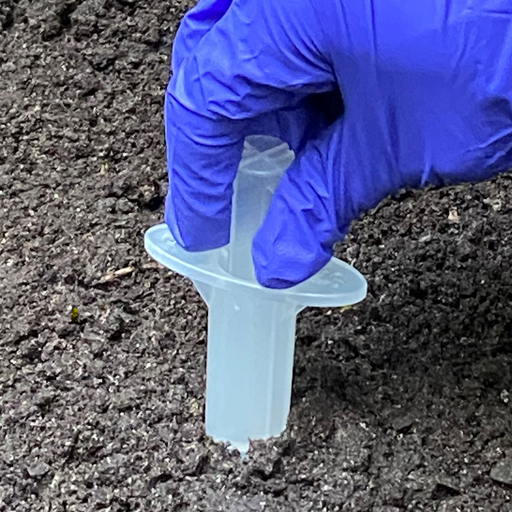
Figure 1. Soil VOC core sampling technique
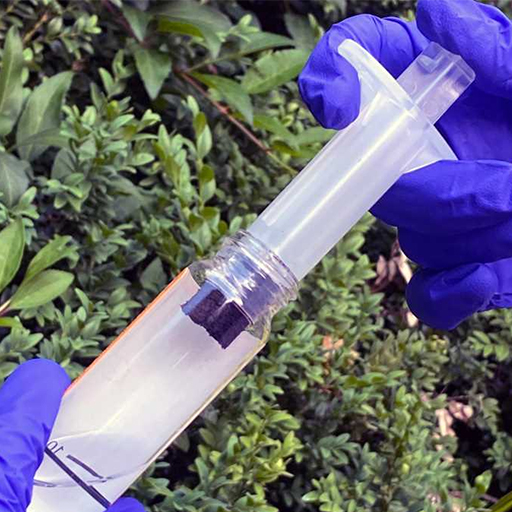
Figure 2. Extrusion of soil plug
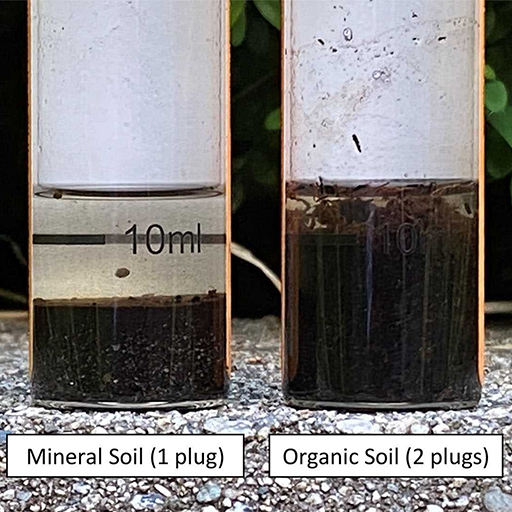
Figure 3. Correct sample amounts
Optimal Sampling Technique
- Wear eye protection, gloves, and appropriate clothing. Review methanol SDS prior to use.
- Check methanol volume at the 10 mL line.
- Label vials with sample details.
- Prepare a new EZE-Core sampler, fully retracting the plunger.
- Remove surface debris to expose fresh soil and collect sample quickly to minimize VOC loss.
- Press and twist EZE-Core into soil to collect ~3 cc (~5 g) wet soil.
- Ensure sample has no rocks or debris; slight overfilling is acceptable.
- Open vial and place lid upside-down on a clean surface.
- Insert EZE-Core into vial at 45° angle to minimize splashing; depress plunger to extrude soil plug.
- For organic soils, repeat to collect two plugs per vial.
- Remove EZE-Core and tightly cap vial; swirl gently to immerse soil in methanol.
- Repeat for additional vials as needed.
- Collect separate soil jar for moisture determination and ship with ice packs to ≤10°C.
Quantifying soil physico‑chemical properties in situ
the Direct Soil Measurement pH Portable Meter Kit provides accurate pH and temperature readings directly from bulk soil samples, while the Watermark Soil Moisture Sensors enable long‑term tracking of moisture status in agronomic or environmental plots. For broader environmental quality monitoring that intersects with soil conditions, the Hygiena Sample Sponge offers a sterile collection medium for surface residue sampling that complements subsurface analyses, enhancing overall site characterization and compliance workflows.
Overview of TDG Rules for Methanol
Methanol is flammable and toxic; transport is regulated under Transport Canada’s TDG rules. Ground shipments under Limited Quantity (outer container ≤30 kg, inner ≤1 L) do not require TDG certification or declarations. Air shipments require stricter IATA regulations, TDG training, and packaging with absorbent material. Excepted Quantities for air are ≤500 mL per cooler (≤30 mL per vial) with "Class 3" marking.
Q&A
Why is field methanol preservation important?
It prevents evaporative and microbial loss of VOCs, improving data quality for analytical testing.
What is the optimal methanol-to-soil ratio?
Approximately 2 mL of methanol per 1 gram of wet soil for effective stabilization.
How do I collect the correct soil amount in the field?
Use the disposable EZE-Core sampler, which delivers ~5 grams per plug. Two plugs may be needed for organic soils.
How long can methanol-preserved samples be held before analysis?
Up to 40 days, except in Ontario where the hold time is 14 days.
Are there special requirements for transporting methanol-preserved samples?
Yes, TDG and IATA regulations apply; use proper labeling, absorbent material, and container limits for safe transport.
| Price | $USD 143.00 |
|---|
Need larger scale equipment for a bigger project?
Our parent site geneq.com works by quote requests, so we can offer a unique price per any combination of items you choose, and the best shipping company/route for weighty items. We distribute the biggest names in the industry since 1972!


