
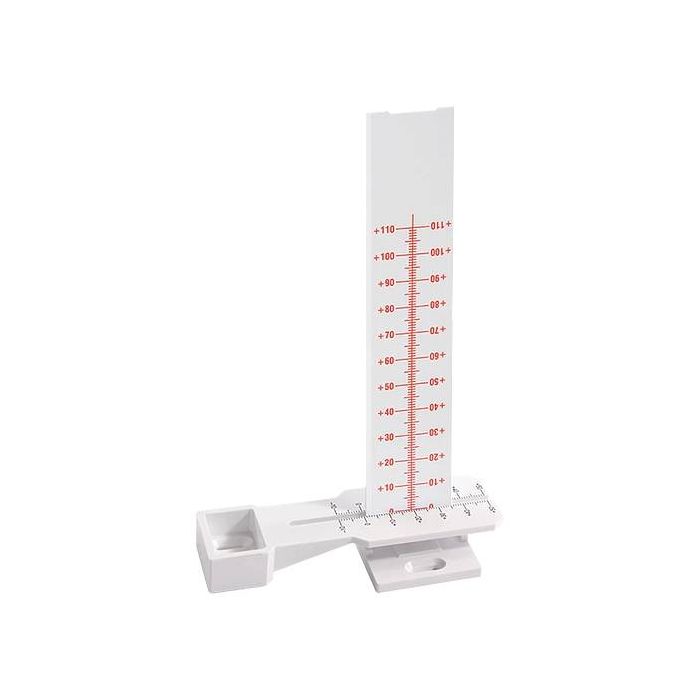
Displacement crack gauge - Humboldt
- 12 months limited warranty
- Monitors horizontal movement and displacement
- Can be fixed to the surface with screws or adhesive
The displacement crack gauge monitors horizontal and displacement movement where there is a step across a crack due to displacement of “out-of-plane” movement.
The Displacement Crack Gauge is used by structural engineers, building inspectors, and restoration professionals to measure and record relative movement across cracks in concrete, masonry, and other structural elements. These gauges provide quantitative data on crack displacement over time, which helps assess whether cracks are stable, widening, or closing due to settlement, thermal expansion, or load‑related stresses—an important part of condition monitoring and structural evaluation referenced in infrastructure inspection guides.
Professionals value displacement crack gauges for their clear graduated scales, durable construction, and ability to support long‑term monitoring programs. Compared with periodic visual estimates alone, dedicated crack displacement measurement tools provide objective, documented data that improve inspection reliability, support quality control in structural assessments, and inform maintenance planning and risk mitigation in construction and restoration applications.
Reliable monitoring of structural crack displacement over time
This displacement crack gauge is designed to accurately monitor horizontal and vertical displacement where a measurable step exists across a crack caused by out-of-plane movement. It is commonly used to track changes over time, helping identify whether a crack is stable, progressing, or responding to structural loads or environmental factors.
Gauge construction and components
The gauge consists of a durable base plate (not calibrated), a calibrated top plate, and a removable graduated ruler. Together, these components allow precise measurement of relative movement between the two sides of a crack.
Measurement and installation
The graduated ruler is removed from the gauge when not in use and is applied only during measurements to assess relative displacement between the plates. The gauge can be securely fixed to the surface using either screws or adhesive (not included), allowing installation on a wide range of substrates.
Typical applications
This type of crack gauge is widely used in structural monitoring, civil engineering inspections, building condition assessments, and infrastructure maintenance. It is valued for its simplicity, repeatability, and ability to provide clear visual evidence of movement without the need for electronic instrumentation.
Supplied with clear installation guidelines and a log sheet, the gauge supports consistent data recording and long-term monitoring in both short-term investigations and ongoing structural observation programs.
Q&A
What type of cracks is this displacement crack gauge best suited for?
It is best suited for cracks with a noticeable step or offset, where horizontal or out-of-plane displacement needs to be monitored over time.
Can this crack gauge be used for long-term monitoring?
Yes, it is suitable for both short-term and long-term monitoring when installed correctly and measured at regular intervals using the supplied log sheet.
Does the gauge require power or electronic sensors?
No, this is a purely mechanical gauge, making it reliable, low-maintenance, and ideal for environments where electronic monitoring is not practical.
How is the gauge fixed to the surface?
The gauge can be installed using screws or adhesive, depending on the surface and application. Fixing materials are not included, allowing flexibility based on site requirements.
| Price | $USD 31.00 |
|---|
Need larger scale equipment for a bigger project?
Our parent site geneq.com works by quote requests, so we can offer a unique price per any combination of items you choose, and the best shipping company/route for weighty items. We distribute the biggest names in the industry since 1972!


