
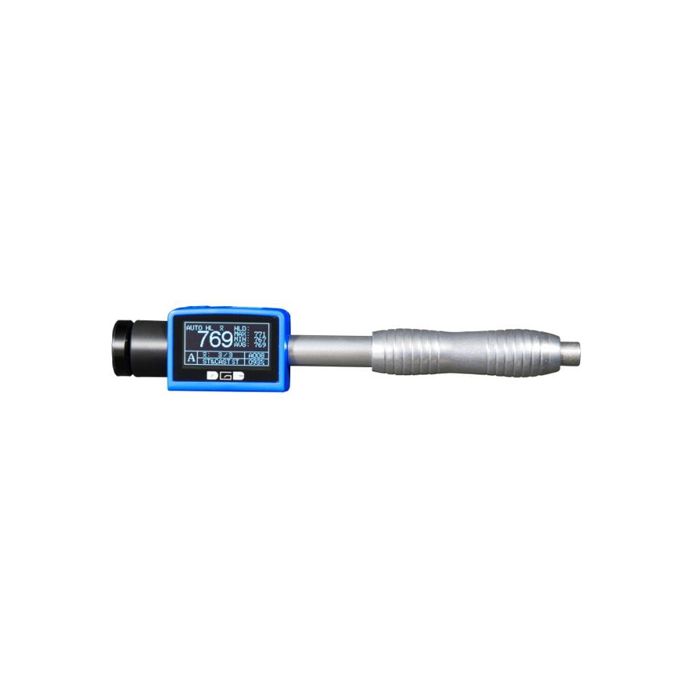
DHT-400 Digital Leeb Hardness Tester for On-Site Metal Testing (HL, HRC, HB, HV)
- 12 MONTHS LIMITED WARRANTY
- Measuring accuracy: +/- 0.5%
- Storage capacity: 1250
- Operating temperature: 0°C - 50°C
The Handheld Hardness Tester DHT-400 utilizes state-of-the-art micro-electronic technology
Compact, Professional Hardness Testing Anywhere
This uniquely designed, pocket-sized hardness tester is engineered for fast and reliable measurements directly in the field or on the shop floor. Supplied with a pocket-sized carrying case, the DHT-400 integrates the hardness impact probe, microprocessor, and data display into a single, rugged unit that is easy to operate with one hand.
The DHT-400 Plus introduces advanced features such as a statistical data display, expanded internal memory, and a USB interface for both recharging and data transfer to a PC or printer. Its bright OLED display ensures excellent visibility even in low-light or enclosed environments. Conforming to ASTM A956, the instrument delivers consistent accuracy across a wide measuring range and automatically converts results to Rockwell, Brinell, Leeb, Vickers, and Shore hardness scales.
Widely used in manufacturing, maintenance, and quality control, the DHT-400 is especially valued for its portability, fast readings, and ability to test large or installed components where traditional bench testers are impractical. Compared to bulkier systems, it offers greater flexibility without sacrificing measurement reliability.
The :contentReference[oaicite:0]{index=0} is a compact, micro‑electronic portable device designed for on‑site material hardness testing across a wide range of applications. It integrates the impact probe, microprocessor, and data display into a single handheld unit that conforms to ASTM A956 standards, providing reliable measurements with ± 0.5 % accuracy and automatic conversion into multiple hardness scales (Rockwell, Brinell, Leeb, Vickers, Shore). The tester includes features such as an OLED display for use in low‑light environments, internal storage for up to 1 250 readings, USB connectivity for data transfer, and automatic statistical calculation of average results, making it suitable for both production quality control and inspection tasks. :contentReference[oaicite:1]{index=1}
Hardness testers like this are especially valuable in industries where material properties must be verified quickly, reliably, and without removing parts for lab testing. Key end‑users include manufacturing and metalworking facilities ensuring proper material hardness during production, automotive and aerospace industries verifying components such as engine parts and structural elements, construction for testing structural metals, and quality assurance teams in warehouses and fabrication shops. Portable hardness testers reduce the need for bench‑mounted equipment by enabling on‑site testing of large, fixed, or hard‑to‑access components, improving workflow efficiency and traceability in quality programs. Industry analysis shows the portable hardness tester market serving sectors such as automotive, aerospace, manufacturing, and construction due to their need for rapid, non‑destructive material verification. :contentReference[oaicite:2]{index=2}
Users and industry sources routinely praise this category of portable testers for their ease of use, minimal sample preparation, and ability to provide immediate results in diverse field environments. Compared with traditional laboratory hardness machines, handheld testers allow technicians to perform measurements directly on assembled parts or in confined spaces without material removal, saving time and reducing production delays. Advantages also include lower overall equipment and operational costs and the ability to document results digitally for quality records. While more advanced bench systems might be required for certain certified testing under ISO or ASTM procedures, portable instruments like the DHT‑400 provide an efficient and cost‑effective solution for routine inspections and in‑process checks across varied industrial settings. :contentReference[oaicite:3]{index=3}
Typical applications
• Testing of large and/or heavy components, including installed machine parts
• In-process testing during manufacturing, particularly for mass-produced components
• Material identification and verification in warehouses or storage facilities
• Hardness testing in difficult-to-access or confined spaces
Technical Data
• Measuring accuracy: +/- 0.5%
• Impact device: Model D, DL, or G
• OLED display
• Hardness scales: HRC, HRB, HRA, HB, HV, HS, and HLD • Automatic calculation of average and mean values
• Storage capacity: 1250 readings
• USB 2.0 interface
• Impact direction: any angle
• Impact energy: 8 ft-lbs (11Nmm)
• Test tip: Tungsten Carbide
• Dimensions: 158 x 41 x 26 mm
• Weight: 120g
• Operating temperature: 0°C to 50°C
Standard package
• Processor integrated with impact device D
• Calibration certificate
• Standard test block
• Software
• USB cord
• Battery charger
• Support ring
• Cleaning brush
• Carrying case
When reliable material characterization is required, hardness measurement is often complemented by additional instruments designed for different testing standards and materials. For example, the DHT-200 portable hardness tester for metals provides a versatile solution for evaluating the hardness of various metallic components and supports multiple hardness scale conversions for broader quality control applications. When testing composites, reinforced plastics, or aluminum alloys, the Barcol HPE II hardness tester offers a specialized method designed for rigid materials commonly found in manufacturing and fabrication environments. In addition, laboratories and production facilities working with elastomers or thermoplastics may benefit from the PTC durometer ASTM – Shore D, which enables precise hardness evaluation of harder polymers, coatings, and similar materials in accordance with ASTM testing methods. Together, these complementary instruments help support comprehensive mechanical property testing across a wide range of industrial materials.
Q&A
What hardness scales does the DHT-400 support?
The DHT-400 automatically converts and displays measurements in Rockwell, Brinell, Leeb, Vickers, and Shore hardness values, covering most industrial testing requirements.
Is the DHT-400 suitable for on-site or in-field testing?
Yes. Its compact design, integrated impact device, and battery-powered operation make it ideal for field inspections and testing of installed or large components.
Can test results be stored and transferred to a computer?
The tester can store up to 1250 readings internally and transfer data via USB to a PC or printer for documentation and analysis.
Does the DHT-400 comply with industry standards?
Yes. The DHT-400 Plus conforms to ASTM A956, ensuring reliable and standardized hardness measurements.
| Materials | HL | HRC | HRB | HB | HS | HV | |
| 30D2 | 10D2 | ||||||
| ST & Cast ST | 300~900 | 20.0~68.0 | 38.4~99.5 | 80~647 | 32.5~99.5 | 80~940 | |
| CWT Steel | 300~640 | 20.4~67.1 | 46.5~100.7 | 80~898 | |||
| Stainless | 300~800 | 19.6~62.4 | 85~656 | 85~802 | |||
| GC Iron | 360~650 | 90~334 | |||||
| NC Iron | 400~660 | 131~367 | |||||
| Cast Alum | 174~560 | 20~190 | |||||
| Brass | 200~550 | 13.5~95.3 | 40~173 | ||||
| Bronzes | 300~700 | 60~290 | |||||
| Copper | 200~690 | 45~315 | |||||
| Price | $USD 1,771.50 |
|---|
Need larger scale equipment for a bigger project?
Our parent site geneq.com works by quote requests, so we can offer a unique price per any combination of items you choose, and the best shipping company/route for weighty items. We distribute the biggest names in the industry since 1972!


